Introduction and coordination by Nitin Bathla
Current Issue
Volume 47, 6
Concrete: the Inconspicuous Binder of Planetary Urbanization
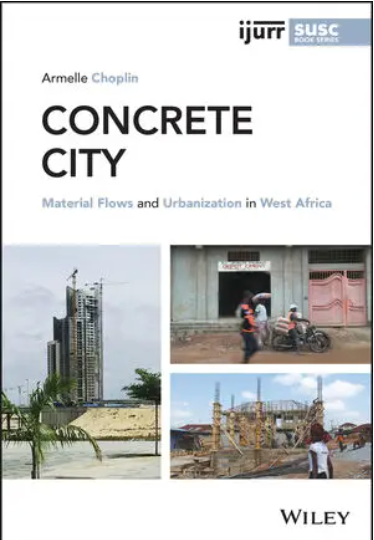
A book review forum with:
Nitin Bathla, Concrete: the inconspicuous binder of Planetary Urbanization
Wangui Kimari, Africa's concrete imaginaries
Alice Hertzog, Tracking the cement bag: a new geography of building
Prince K. Guma, Urban lives, worlds and frontiers of (and beyond) the Concrete City
Introduction: Concrete: the inconspicuous binder of Planetary Urbanization by Nitin Bathla
Recent years have witnessed a renaissance in scholarship on urban Africa. As diverse and variegated strands of research push back against dominant narratives and examine the continent’s positioning as the “final frontier” of urbanization as well as transnational capital investment, scholars have illuminated the colonial continuities shaping urban fabric (e.g., Kimari & Ernstson, 2020). They have also analyzed the role of the middle class in producing urban property frontiers in cities such as Dar es Salaam (Mercer, 2024), and investigated the impact of infrastructure corridors on African urbanization (Silver, 2023), revealing patterns that are uneven, incomplete, and often non-linear (Guma, 2020).
A common binder of these diverse modalities of African urbanization – concrete – often remains in the background, despite its local and world historical significance. In the 21st-century city, concrete is king: a pourable material capable of taking shape anywhere, symbolizing aspirational modernity. Yet, it is also the very condition of possibility for the scale, speed, and extent of contemporary urbanization.
Armelle Choplin’s (2023) brilliant new book, Concrete City, casts a critical lens on this material, flipping its geography inside out. She explores how concrete shapes urbanity along the Lagos–Abidjan corridor in West Africa – a 1,000-kilometre-long grey, monochrome landscape where the remaining palm trees struggle to survive amid the thousands of tons of concrete poured in recent years (Choplin, 2023, p. 8). Concrete is everywhere. It not only gives form to urban space where politics unfolds but is itself deeply political in itself. The ways concrete comes into being – through extraction, labor, and enclosure of resources from both proximate and distant territories – are inherently political processes.
But what is concrete? Choplin shows us that it is more than just cement. While cement – the binder – is produced by transnational corporations and African capitalists, concrete also comprises locally quarried aggregate and sand, steel, and water drawn from nearby reservoirs and commons. She immerses us in these sites of extraction, bringing us close to the women in the suburbs of Cotonou and Accra who carry sand in baskets from “perforations in the lagoon” (Choplin, 2023, p. 95). She reveals how the vast quantities of water needed for concrete production are often taken for “free” from borewells or nearby lagoons. How Indian, Lebanese, and Chinese entrepreneurs vie for control and centrality in these networks, supplying steel rebars and sheet metal – key components of concrete construction.
This careful forensic ethnography builds on Choplin’s previous work tracing the inconspicuous globalization of everyday objects, as Alice Hertzog (2025 forthcoming) notes in her review in this forum (Choplin & Pliez, 2015). While her previous work, Choplin has analyzed the discreet geography of retial trade, in Concrete City, her dissection of cement’s production offers much greater surprises. For example, she explains that clinker – a crucial cement ingredient – is so energy-intensive to produce that it costs more than twice as much to manufacture in Africa than in China or Indonesia, where cheaper energy and manufacturing infrastructure make it cheaper. As a result, even after accounting for the high cost of shipping this heavy material, it is cheaper to import Chinese clinker than to use local African sources (Choplin, 2023, p. 37, 39). This attention to material and metabolic flows – simultaneously planetary and local – reveals the falsely inert status of concrete. As Wangui Kimari (2025 forthcoming) reminds us in this forum, concrete is not merely a passive medium for capital accumulation; it is an accumulation in itself.
To me, Choplin’s scholarship marks a critical contribution to what might be called the ethnographic turn in Planetary Urbanization – an approach that grounds the abstract in lived, material extensions such as the Lagos–Abidjan corridor, while tracing their entanglement in global metabolic networks. My own work aligns with this turn, as does the recent scholarship of – Monika Streule (2020), Lindsay Sawyer (2014), Lindsay Blair Howe (2017), Alice Hertzog (2020), Metaxia Markaki (2024), Rodrigo Castriota (2024) and myself (Bathla, 2024) to name a few. One shared achievement of this emerging body of scholarship is the abandonment of methodological orthodoxy. As Prince Guma (2025 forthcoming) notes in this forum, Choplin fluidly draws on STS, postcolonial theory, and Lefebvrian spatial analysis, enacting methodological anarchy.
One of the book’s most important contributions is its careful disassembly of concrete as a multi-scalar material assemblage. The book highlights how concrete is produced through extractive processes that are embedded in quarries that are at times local, but as well as spread over the planet. The book highlights how concrete is shaped not only by multinational corporates from the Global North, but also South-South entrepreneurial networks. As such, Concrete City should be compulsory reading not only for scholars in urban studies, but also for civil engineers, material scientists, architects, and planners working in concrete cities across the globe.
Sustainability, then, cannot be achieved simply by reengineering the material composition of concrete that may make the material appear more sustainable through the addition of plant-based substrates for instance, but in fact it is a social relation. We must also rearticulate its socialization: interrogating how it emerges from the commodification of commons and asking how it might be produced otherwise. What might new material commons look like as the materialization of concrete locks us in a spiraling crisis? These are urgent questions – not just for Africa, but for the urbanizing planet at large. As Wangui Kimari notes, in an era where states increasingly attempt to “govern through concrete,” we must attend to how the majority-urban world upholds property regimes (Mercer, 2024) and how trajectories of incompleteness (Guma, 2020) might open portals to an urban otherwise (Bathla, 2024).
Readers should note that this review forum is accompanied by a podcast produced by the team of Urban Political Podcast. It includes conversations with Prince Guma, Wangui Kimari, and Alice Hertzog, and can be accessed here: https://urbanpolitical.online/86-book-review-concrete-city/
References:
Bathla. (2024). Extended urbanisation and the politics of uncertainty: The contested pathways of highway cor-ridors in India. The Geographical Journal, 190(1), e12441.Blair Howe, L. (2017). Thinking through peripheries: Structural spatial inequality in Johannesburg [Doctoraldissertation]. ETH Zurich.Castriota, R. (2024). “Here, Vale is the State”: Neoextractivism and authoritarianism in the city, the country-side and the forest in the region of Carajás. Revista Brasileira de Estudos Urbanos e Regionais, 26(1),e202408. https://doi.org/10.22296/2317-1529.rbeur.202408Choplin, A. (2023). Concrete city: Material flows and urbanization in West Africa. John Wiley & Sons.Choplin, A., & Pliez, O. (2015). The inconspicuous spaces of globalization. Articulo-Journal of Urban Research,12, 1–17.Guma, P. K. (2020). Incompleteness of urban infrastructures in transition: Scenarios from the mobile age inNairobi. Social Studies of Science, 50(5), 728–750. https://doi.org/10.1177/0306312720927088206 BOOK REVIEW FORUM
Guma, P. K. (2025 Forthcoming). The urban lives, worlds and frontiers of (and beyond) the concrete City.Urban Geography.Hertzog, A. (2020). The Lagos Abidjan corridor: Migration driven urbanisation in west Africa [Doctoral dis-sertation]. ETH Zurich.Hertzog, A. (2025 Forthcoming). Tracking the cement bag: A new geography of building. Urban Geography.Kimari, W. (2025 Forthcoming). Africa’s concrete imaginaries: A review of Choplin’s ‘concrete City.’ UrbanGeorgraphy.Kimari, W., & Ernstson, H. (2020). Imperial remains and imperial invitations: Centering race within the con-temporary large-scale infrastructures of East Africa. Antipode, 52(3), 825–846. https://doi.org/10.1111/anti.12623Markaki, M. (2024). ARCADIA: Politics of Land and Nature-From peripheralisation to extended citizenship[Doctoral dissertation]. ETH Zurich.Mercer, C. (2024). The suburban frontier: Middle-class construction in Dar es Salaam, p. 222. University ofCalifornia Press.Sawyer, L. (2014). Piecemeal urbanisation at the peripheries of Lagos. African Studies, 73(2), 271–289. https://doi.org/10.1080/00020184.2014.925207Silver, J. (2023). The infrastructural south: Techno-environments of the third wave of urbanization. MIT press.Streule, M. (2020). Doing mobile ethnography: Grounded, situated and comparative. Urban Studies, 57(2),421–438. https://doi/10.1177/0042098018817418
Choplin, A. (2023). Concrete city: Material flows and urbanization in West Africa. John Wiley & Sons.