Current Issue
Volume 47, 7
Hustle Urbanism Making Life Work in Nairobi
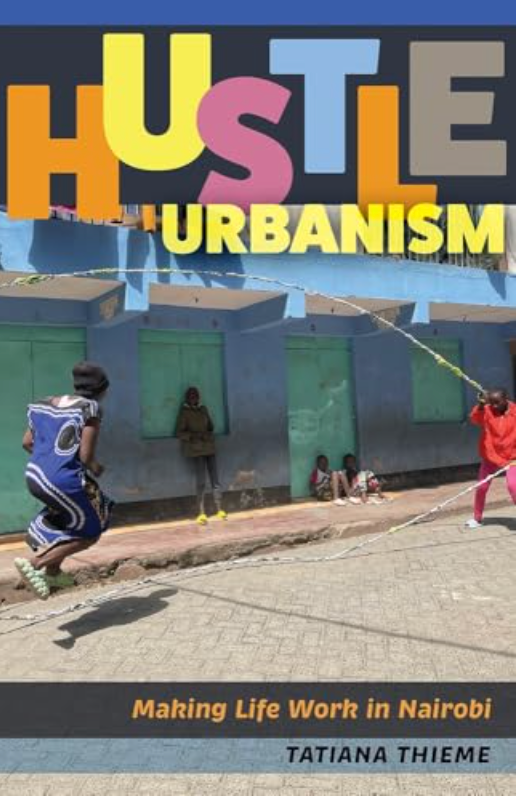
A book review forum with:
Yoonai Han, Hustle urbanism and the urban otherwise, beyond the post-industrial cities
Harry G. Pettit, Hustle as refusal: refusing categorization, refusing intervention, refusing progress
Prince Guma, Incomplete geographies of hustle
Jessie Sullivan, Creative resistance in the in-between: hustle in liminal urban space
Tatiana Thieme, Re-reading Hustle Urbanism with others
Thieme, T. (2025). Hustle Urbanism: Making Life Work in Nairobi. University of Minnesota Press.
Hustle urbanism and the urban otherwise, beyond the post-industrial cities by Yoonai Han
Hustle has emerged as a puzzling concept for urban thinkers. It resists the class connotation that the term precarity often entails, or norms around the formal world that informality implies. Hustle is increasingly less supplementary to a full, major job. As the supposedly transient state of hustling becomes prolonged and conceptual debates emerge, it has quickly gained colloquial names across geographies. While side hustle, side project, or gig may be familiar to Anglophone readers, there are also enjab (in South Korea), freeta (in Japan), fuye and slash youths (in China), and jugaad (in India), and waka (in Nigeria), among many others. As puzzling as its irreducibility to (working) class, job category, precarity, or populist political subjecthood may be, academic discussions tend to ground hustle and related terms in reserve or surplus labor force in cities of the post-industrial world. In a nostalgic tone, hustle is seen as residuals unable to be absorbed into regular employment amid macroeconomic shifts, namely, industrial upgrades, automation, eroding social protection, and retreat of the once-thick working class. Such formulations from a birds-eye view offer analytical clarity and perhaps political valence to problematize conditions of chronic surplus production. Yet, they inevitably flatten the ambivalent beings involved in the process of making and becoming hustlers and thereby losing sight of agency.
Defying the temptation of categorization, Hustle Urbanism narrates the story from and within the streets and youths’ bodies on the move, through Tatiana Thieme’s rich ethnographic accounts. This forum joins that defiance, proposing to re-couple hustle and the urban by reading and thinking together with Hustle Urbanism and against the persistent association of hustle with narrow imaginations of the urban as post-industrial cities. Contributors to this forum, like the author of the book, have troubled such provincial associations through their recent and ongoing reflections on hope and meritocracy (Pettit, 2019), incompleteness and infrastructure (Guma, 2020), environmental biopolitical control of the marginalized (Lambert & Sullivan, 2026), and contingency as urban conditions (Han, 2025). The forum sits at the intersection of these trajectories and critiques and is formed as a conversation of the author and readers, with the hope of enriching urban scholarship on hustle and pluralizing hustle.
Among the varying meanings and images that hustle carries with it, underemployment isperhaps the most strongly associated. Hustle Urbanism unsettles the worldviews that construct this association. The book begins to narrate the hustling youths in Nairobi by critically questioning the normative expectations of full employment and the linear imaginaries ofdevelopment and progress. As Thieme shows, this critique involves choosing to “let go”rather than “hold onto” (Thieme, 2025, p. 56) the imaginaries of full employment, proper job (Ferguson & Li, 2018), and the welfare state, each anticipating that hustlers will eventually return to full employment as the normal state.
By letting go of these normative imaginaries, Hustle Urbanism makes visible possibilities of the urban otherwise and invites readers to journey through hustling as a dance style, shrewd survival tactic, racialized, classed, and gendered marginality, solidarity, and resistance. Theseplural registers of hustle across time and space set the scene for decoupling hustle from themajority world. It is a mode of thinking that the author advances to challenge the Global North/South divide deeply ingrained in urban knowledge production and to think with (Thieme, 2025, p. 3) the popular neighborhoods of Nairobi.
Through the chapters, readers encounter the in-between spaces of “letting go”. Mtaa (hood) of Mathare spatializes the waiting, hope, and survival. Aspirations around the state of not-yet-there and getting there become palpable through the handcarts transportingwaste, plastic chairs, a wobbly table, and a wooden shed that serves as the office of a youth social enterprise. These spaces, bodily movements, and affects stand apart from start-up labs, festivals (Puar, 2012), entrepreneurial incubators, and governing institutions in the majority world that tend to aestheticize transience and waiting of the floating youths as a choice of digital nomads or innovative technology frontiers, while promoting the neoliberal mantra of “do-what-you-love”.
Viewed through familiar lenses, such spaces and youths may fall under singular labels:entrepreneurial hubs, precarious youths, or street economy. Yet by letting go, Hustle Urbanism shows how a former school drop-out becomes a circular economy pioneer, recast as an institutionally recognized garbage collector and praised local partner for international organizations. In doing so, Thieme illuminates the institutional forces that define what counts as“good hustle”, what activities enter a young entrepreneur’s “portfolio” (or what can be put on CVs), and what remains in the realm of loitering and endurance. Here, the policynotion of self-reliance and corporate investor’s statement of break-even point converge around the making of hustler subject and hustler nation. Rather than seeing from the above and diagnosing these as forms of governance or co-optation, the book grounds itselfin the streets and backyards of Mathare and lets the generative agency of Nairobi’s youthsto emerge as they move across and beyond imposed labels.
Central to this generative agency is a historically inscribed aspiration for autonomy. The “refusal to be someone else’s donkey” (Thieme, 2025, p. 110), as one interviewee puts it, runs through Kenya’s (post-)colonial history and everyday politics of contestation. Against this backdrop, hustle gains meaning beyond self-employment, becoming “a language of action and resistance” (Thieme, 2025, p. 274). As the rich encounters throughout the book reveal, this language and ethos are shared by many youths in Mathare, those who stay, leave, or return to the mtaa economy, under the collective identity of the hustler. Building from these reflections on autonomy and agency lead to a question that I hope to share with fellow readers: how might the agency of the hustler foster a collective reading of shared transience, rather than an individualized run toward survival? In other words, how does the increasingly normalized condition of self-employment resist being reduced to self-salvation?
To ground this question, I draw from plural geographies where hustle takes on distinct forms of agency. In the fiction Nomadland, a hustler drifts through seasonal jobs in North America eventually joining an autonomous van community in the desert to break away from the exploitative system. In most realities, however, hustlers carry on the slash-and-burn existence without the means to depart from it entirely, despite awareness of systematic injustice. This suspended state often produces a withdrawal from the present, as seen in theeveryday lives of migrant workers in China (Xiang, 2021). In South Korea, waste collection (atype of hustle that was formerly in a gray area and later became a recognized youth enterprise in the book) is largely carried out by elderly “cardboard grannies”, denied fair employmentand welfare access. Young people objectify, rather than problematize, this structural exclusion and use it as energy to optimize one’s own life strategies. Rarely but when problematized, the precariats are seen as the Others to be helped out (Cho, 2022), often accompanied by moralmotivations. Hustling is practised as an evasive and transient state to exit as fast as possible(Han, 2025), while collective reading of transience is seen as an unaffordable luxury. Positioning hustlers in Mathare as either victims or moral frontiers of the commons would reproduce the very categorizations that Thieme cautions against. Hustle Urbanism calls for a break from both victimizing and romanticizing gazes.
This forum is a dialogue of geographers who have thought with and practised the urban otherwise in their respective fields. Contributors have challenged understandings of the urban as post-industrial that has persisted in geography. The forum also makes a unique constellation of the contributors’ ongoing and recent ethnographies on marginal youths that break away from the view from above. The reviews take hustles as a generative force to reflect on Western interventionism, theorizing from African cities, and ethnographies on the in-between, through which the ideas of hustle resonate with and beyond Nairobi. The forum continues with Harry Pettit’s reflections on hustle as refusal (Pettit, 2026). Guiding the readers through hustling youths from Nairobi to Cairo, Harry calls for academic concepts and practices for the people living through injustice. Jessie Sullivan travels through her recent fieldwork in Amman to Nairobi, inviting us to reflect on what it means to research hustles in times of poly-crisis and where ethnography sits within thishistorical time (Sullivan, 2026). Through a focus on temporalities and spatialities of African cities, Prince Guma prompts thoughts on what hustle as method and frameworkenables and also obscures (Guma, 2026). The forum closes with Tatiana Thieme’s response that guides us into the life and afterlives of the book writing “beyond the page” (Thieme, 2026), through which the forum hopes fellow readers to join dialogues on the geographies of hustles.
References
Cho, M. Y. (2022). The precariat that can speak: The politics of encounters between the educated youth and the urban poor in Seoul. Current Anthropology, 63(5), 491–518. https://doi.org/10.1086/722026
Ferguson, J., & Li, T. M. (2018). Political-economic analysis after the century of labouring man.
Guma, P. K. (2020). Incompleteness of urban infrastructures in transition: Scenarios from the mobile age in Nairobi. Social Studies of Science, 50(5), 728–750. https://doi.org/10.1177/0306312720927088
Guma, P. K. (2026). Incomplete geographies of hustle. Urban Geography.Han, Y. (2026). Countdown city: contingency as urban condition, hustle as exit, and everyday crisis in Seoul.City, 30(1-2), 455–471. https://doi.org/10.1080/13604813.2025.2569971
Lambert, R., & Sullivan, J. (2026). Environmental justice and the (re) production of sacrifice zones: The impact of migration policies and practices in the Aegean. Geopolitics, 31(4), 1619–1645. https://doi.org/10.1080/14650045.2025.2558873
Pettit, H. (2019). The cruelty of hope: Emotional cultures of precarity in neoliberal Cairo. Environment andPlanning D: Society and Space, 37(4), 722–739. https://doi.org/10.1177/0263775818825264
Pettit, H. (2026). Hustle as refusal: refusing categorisation, refusing intervention, refusing progress. Urban Geography, Advance online publication. https://doi.org/10.1080/02723638.2026.2706832
Puar, J. (Ed.). (2012). Precarity talk: A virtual roundtable with Lauren Berlant, Judith Butler, Bojana Cvejić,Isabell Lorey, Jasbir Puar, and Ana Vujanović. TDR/The Drama Review, 56(4), 163–177. https://doi.org/10.1162/DRAM_a_00221
Sullivan, J. (2026). Creative resistance in the in-between: Hustle in liminal urban space. Urban Geography,Advance online publication. https://doi.org/10.1080/02723638.2026.2706847
Thieme, T. (2025). Hustle Urbanism: Making Life Work in Nairobi. U of Minnesota Press.Thieme, T. (2026). Re-reading Hustle Urbanism with others. Urban Geography.
Xiang, B. (2021). Suspension: seeking agency for change in the hypermobile world. Pacific Affairs, 94(2), 233–250. https://doi.org/10.5509/2021942233URBAN GEOGRAPHY 1685